to losing a day in the mix

to losing a day in the mix

Monday, December 17, 2012

Lilian Medford and the Philosopher's Walk


While I didn't get there until over half of the semester had gone by, in the past month, I have been to Kyoto many times. One of the virtues of being situated in Osaka is the easy access to so many surrounding areas of historic and cultural interest, like Kyoto, which takes about 45 minutes for me to get to by train.


Kyoto, as the previous capital of Japan, has probably the highest density of places of interest. With 17 Unesco World Heritage sights to boast, there was no way to see it all. But I'll give you a highlight of the main sights I've seen. It certainly makes me thankful that, however morbid, the U.S. government ruled out Kyoto as a possibility for the dropping of atomic bombs during WWII specifically because of its historical and cultural significance. I'm happy to have been able to see it as the widely traditional city it is.


First, when Amber's great aunt Barb came to visit from Minnesota, we went on a little adventure to Nijo Castle. This is the home to the Nightingale Floors, which are floors that were designed to make noises when walked upon. They were intended to ward off ninja assassins, because the chirping floors were impossible to cross without making noise. Nijo castle was constructed during the Tokugawa shogunate, so there was a lot of historical reason for the shogun to be concerned about assassination attempts.


Unfortunately, we weren't permitted to take photographs inside the castle itself, but the above are pictures of the beautiful grounds.


The next time I went to Kyoto was for a Koyou night-viewing event. Koyou means the changing autumn leaves, and throughout Japanese history, the ritual viewing of the changing autumn leaves has been of the utmost importance in the yearly schedule. These kimono-clad women were perhaps also returning from a viewing, stepping back into modern culture.


In front of the temple stood several 800-year old Camphor trees. They were magical in the night air and I spent several minutes with friends re-enacting the "My Neighbor Totoro" raising of the Camphor tree.


We went on a beautiful clear night with a group from our school. There are Koyou night viewings throughout the city, but we went to the one at Shorenin temple. It was really stunning, and the photos don't do it justice.


One nice thing about Kyoto is that it is more mountainous than Osaka, so you can get amazing views of the city by just getting to the top of small hills.


Case in point: Kiyomizu-dera temple, our next stop on this flash sight-seeing tour. Kiyomizu-dera, a huge Buddhist temple site, was built to accommodate large numbers of pilgrims, so it was made on several different levels above the earth, the height of which is this amazing veranda.


The Japanese idiomatic equivalent of "to take the plunge" is "to jump off Kiyomizudera." And this expression has historical significance, of course. According to wikipedia, two hundred and thirty four individuals took the plunge during the Edo period, and 85% of them survived! That's impressive, considering it's a 13 meter drop.


The same day, we walked from Kiyomizu-dera to Ginkaku-ji, on opposite sides of the city. On the way, we had lunch in Gion (the famous Geisha district, though we didn't see any), and happened to walk through Heian Jingu by chance, a site we probably wouldn't have otherwise gotten to see. This is the giant Torii gate that leads to the temple, right in the middle of the hustle and bustle of Kyoto.


This day was not just one of the best experiences in terms of sightseeing, as we got to do a lot for such a short period of time. But it was also a day of magic. On the way to Ginkaku-ji (below), we walked along the Philosopher's Walk, a canal famous as the meditation spot for Japanese philosophers.


Ginkaku-ji is sorely under-rated in guidebooks and by word of mouth. Perhaps we went when the leaves were just right, but the grounds were amazing. Ginkaku-ji and Kinkaku-ji were both famous properties of the once rich and famous, two brothers' mansions in Kyoto now converted into temples for the tourists.


Kinkaku-ji was covered in gold leaf (see down below), so the brother intended to cover Ginkaku-ji in silver leaf, but died before he could do it. That's sad, true, but the grounds themselves make for a much more interesting experience than at Kinkaku-ji.
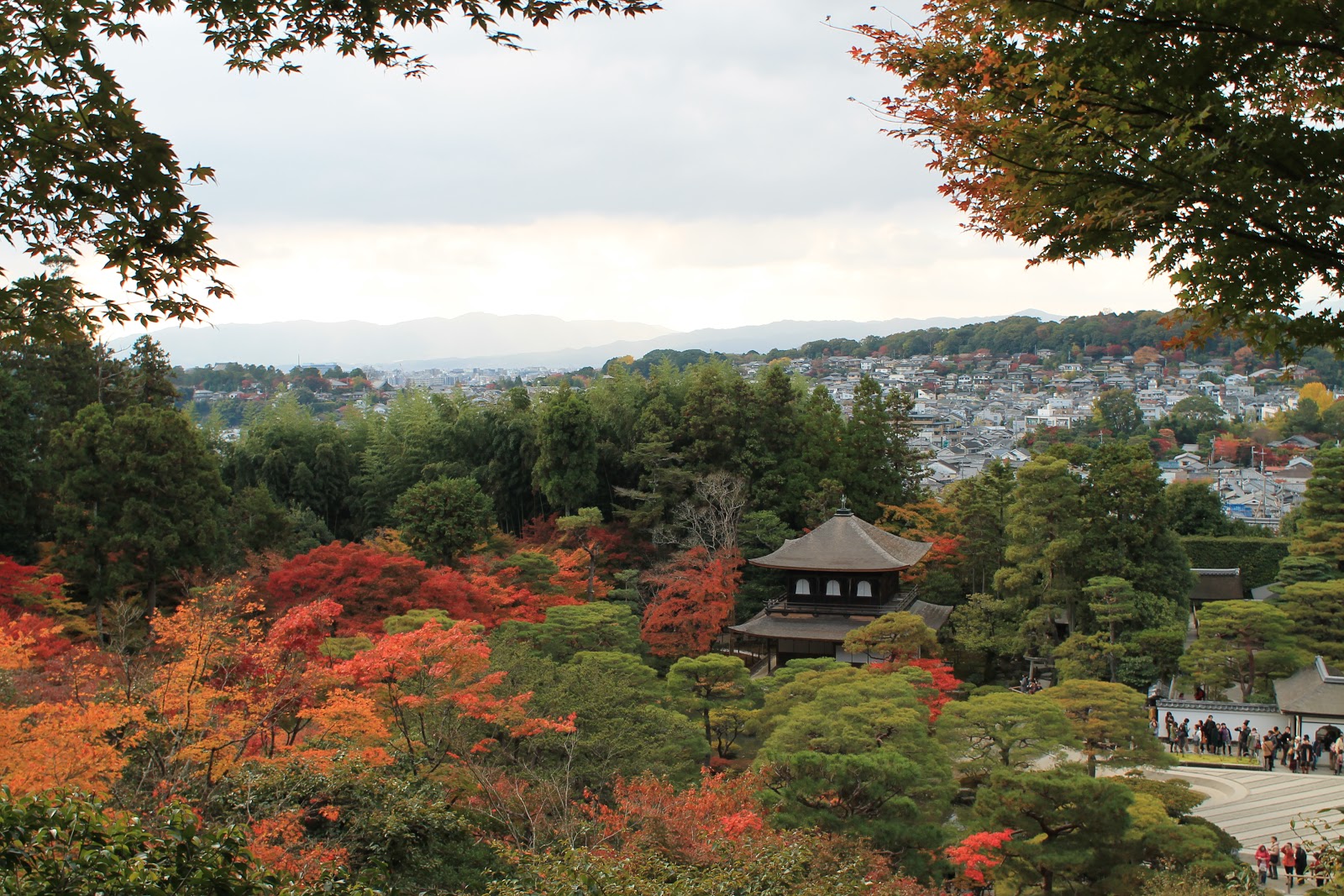

I enjoyed both thoroughly, don't get me wrong, but it's not just that I'm a fan of the underdog. No matter what you may hear or read, believe me when I say that if you only have time for one while you're in Japan, should you ever find yourself here, take a stroll through Ginkaku-ji rather than step into the postcard of Kinkaku-ji.


Because for how absolutely fabulous Kinkaku-ji was, you can get the amazement from looking at a postcard, or at my photos, whereas my photos don't do the same justice to the awe I experienced while walking around Ginkaku-ji.


Now it's time for a magical story of a magical day in Kyoto. Once upon a time, there were three American girls who biked to school together every morning. These three girls would pass the same group of jolly old men, taking their daily walk together. The girls would say good morning, and the old men would give them high fives as the girls passed by on bike, or offer jokingly to push them up the one hill they had to climb to go on their merry ways to school.

One day, far away from America, and far away from their home in Japan, as the girls were walking along the Philosopher's Path, they met the old men! The same old men that they saw every day more than an hour away!! The girls looked at them, and wondered if it was really them, and the men looked at the American girls, and wondered whether it was really them, until finally the whole lot of them burst into laughter in jolly merriment and exchanged stories right there on the edge of that tree-lined canal where great thinkers once thought.

Indeed, we did see them that day, and that super fun experience of running into them made me feel so at home. This world is so small, and even in a nation jam-packed with millions of people, you can still see your neighborhood retirees on their morning walk, wherever you go.

That made me also feel like everything happens for a reason. I was meant to be there with my roommates, the people I go to school with every day, to see those men, the men we see every day. So I wasn't as upset as one might assume when it came to my attention that my visa for France would not come through. I have had to postpone my time in France until a later date yet to be determined. However, when one thing goes wrong, usually something good also comes your way. And came it did. My loving grandmother (if you remember when I wrote about mah-jong, she's the one we play with) offered to fly my cousin, Christopher Paul, to come visit me in Japan. And together, we will travel the globe until I return to the United States next month. He gets here in two days, so there's more to come on those adventures! Hakuna Matata, while not exactly a Japanese phrase, is a philosophy worthy of stumbling upon on my philosopher's walk.


Saturday, December 15, 2012

学校


This semester has been absolutely amazing in so many ways. The people I've met, the places I've been, the things I've seen, the miscellaneous experiences I've had. Looking back on it as it comes to a close, I realize that given the opportunity, I wouldn't change the way I've spent my time here, even if I might choose to add some time on so I could do more.


However, the academics of my program were a constant struggle. The level of depth expected in class was nothing like the level expected at Brandeis, but it was still the most challenging part about living in Japan.


The teaching style is different. So different. I was expecting, as is customary in Japan (and most Asian cultures) more rote memorization. I was expecting to hear "try hard" and "try harder" even when doing my best. These are staples of education in Japan (interesting, recent NPR story: http://www.npr.org/blogs/health/2012/11/12/164793058/struggle-for-smarts-how-eastern-and-western-cultures-tackle-learning). However, as that story suggests, even though Japanese students struggle more, they also seem to be recognized for their hard work (the American "you're so smart" mentality versus the East-Asian "you worked so hard"). Coming into this system as a college student, however, means that the praise of early education is all gone, and you're on your own. Period.


I came into this semester behind. I had done exceedingly well all last year in my Japanese class, but when I came here, I quickly realized that I was expected to know a lot more than I did. The reason: different textbook. All last year, I was using what I still consider to be a BETTER language learning textbook program, Nakama I, that just happened to cover less material than Genki I did. So coming into Genki II without knowing more than half of the verbs I should've known, 50 individual kanji (characters) and dozens of kanji compounds, and quite a lot of grammar points was a struggle. Let alone the inevitable fact that when one teacher uses a textbook, the language that she uses in the classroom is invariably linked with that of the textbook (so not only was I lost in a sea of material I hadn't covered, but I had to go through class that way, too).


It was all ridiculously difficult catching up. And for those first few weeks, I spent between three and six hours every day studying, just trying to get my head above water again so I could stop drowning. But after weeks of that (I think I was mainly caught up, perhaps 80% by about the end of October, which was 2 full months into the semester), I found myself thoroughly disheartened at the fact that my teachers didn't seem to recognize the amount of effort I had had to put in.

One of the virtues of having a program with a total of 9 students is the amazing teacher student ratio. I am one of two students in my class. But when I would approach my teacher for extra help in those first few weeks, her advise was simply, "Try harder. Study more. You'll be able to catch up if you do that," never recognizing that there simply were not enough hours in the day to "try harder" or "study more," and that's not just an excuse based on the fact that I was in Japan and had things I would rather be doing and experiencing than studying for 6 hours on a weeknight.


I pride myself on my sleep, as many of you know (8 hours every night!!), but sleep is a bad thing in Japan. Our roommates will consistently go to bed at 4 or 5am only to get up at 7 or 8am and go to school. There is an axiom in Japan that says that if you sleep more than 4 hours on the night before a test, you will fail. And sleep is not considered a part of mental health, because frankly the concept of mental health doesn't exist here (not even going to go into that now), and people who sleep more are considered weak. But the long and short of it is, I've had to alter my expectations for sleep in order to do fun things, and I hate that. I understand that it is STUDY abroad, but I didn't want study to be all I was doing.

I have qualms with the principles of language learning being blatantly ignored in the Japanese classroom. I hate that rote memorization, and parroting, are how we attempt to master this language, and that creativity in any manner is stifled. I know I'm biased by western culture, with western rules and western research, but as a future language teacher, I have to say that this teaching style goes against everything I've ever read, and everything I've ever heard about how we, as human beings learn language.


One of the positives of my program (I will shortly get to more of them, don't worry), is that I've been able to see special lecturers and performances, and for that I'm grateful. I recently attended a guest lecture by Dr. Marjo Mitsutomi, a Finn whose passion for foreign language teaching methods has led her to Japan to try to reform these "backwards ways."

She argued that the way the Japanese teach language is with a "bonsai approach." Bonsai trees are perfect, meticulously kept with care and attention given to each branch. They are beautiful. But there are no mistakes allowed in a bonsai tree, no individuality, so trees that should grow high to the sky are stunted. She argues for a "banzai approach:" enthusiasm, engagement, sometimes mistakes, but always happiness in the language learning process, a buffet of possibilities for every sentence, rather than a steadfast formula.


Needless to say, I agree with her. This semester has been so frustrating in a class that doesn't value integration, in a class where I was told that it would be better not to use the kanji I know on the grammar portion of my tests because it naturally takes me longer to write in kanji, and I'm not being graded on kanji there. If I'm not forced to use kanji on a test, I implore you, when will I ever use and learn kanji on my own? And while I don't think that testing should be the main method of evaluation in language learning, if it is... shouldn't it at least be comprehensive? 

So those are my frustrations, and certainly ones that I hope to remember going into my teaching experiences in the years to come.


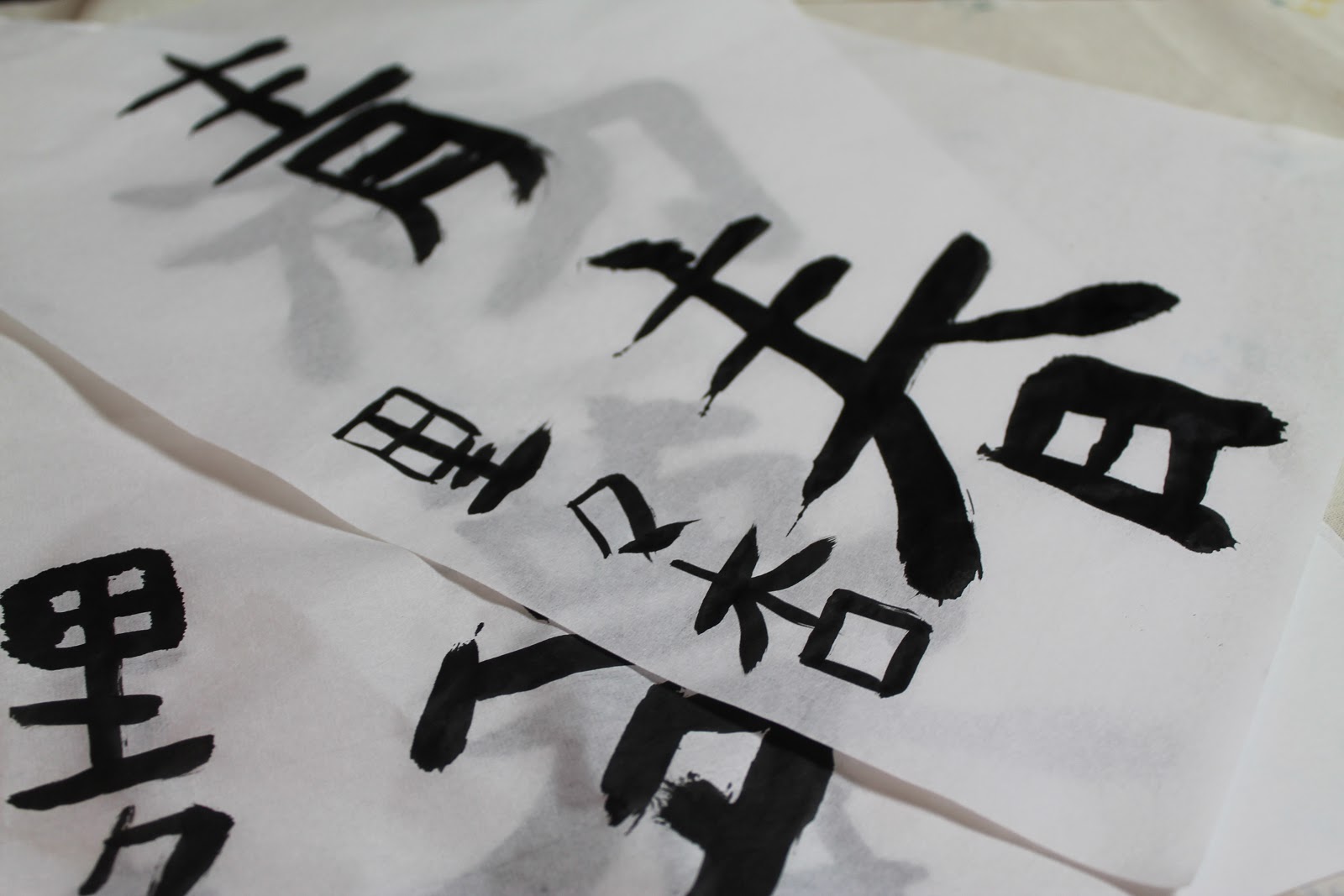
There are however, many great things about my program here in Osaka. All the pictures before this have been of our beautiful campus at Osaka Gakuin University, which has been a nice place to spend time. More valuable still have been the cultural events put on by our landlady Ariyama-san, such as this Japanese calligraphy event we had, wherein we learned the very basics of traditional calligraphy.


The frequency of fieldtrips has also been nice. We've explored the history of Japan (such as the time we went to the Osaka Museum of Housing and Living and walked through the streets of a realistic life-size model of an Osakan neighborhood during the Meiji Period) and the culture (such as last week when we went to try our hands at Ikebana, the traditional art of flower arrangement). These have bee rewarding experiences.


To break up the monotony of the day, we do also have electives in addition to the 2-3 hours a day of Japanese class. My environmental law class has been worthwhile all the way, and the professor is truly amazing and took us out one day (when we were studying UNESCO) to a Heritage site, Tenryu-ji temple, in Arashiyama, Kyoto.


That trip was specifically fun because the purpose was to decide for ourselves whether or not the preservation of cultural heritage through UNESCO's program was worthwhile. So taking in the wabi-sabi aesthetic of the nature as it interacted with the temple grounds, we got to weigh in the pros and cons of tourism and the like, all while on a really fun fieldtrip.


To tie it all together, our professor took our class out to eat at a traditional Bento restaurant. Bento boxes are essentially Japanese to-go boxes, but bentos are created with such care and attention to detail that that description doesn't really do it justice. This traditional style of bento had 3 boxes, in a stacked box container reminiscent (in my mind) of a mah-jong set box, and each of the boxes inside was ornately designed with light seasonal foods. This dinner was also so we could decide whether or not Japanese cuisine deserves to join the ranks of the tangible cultural heritage UNESCO food groupings with Mediterranean, French, and Turkish cuisines (currently in debate). It is this type of interaction between class material and direct cultural interaction that has been the saving grace keeping me from going insane.


In addition to events like that guest lecture I went to, we've had fun events like this musical performance. This event series in particular was a university-wide series called "Inspire Me" and inspire me it did. The group that came most recently was a band from Kyoto called Drakskip, and they play Scandinavian folk-style music. 


They were brought in because they graduated from college just 5 or so years ago, and have done a lot towards achieving their dreams since then. They each talked a little bit about their experiences and played some of the most amazing music I've had the pleasure of listening to in my entire life. They were captivating and certainly memorable.


Lastly in terms of the academic enrichment side of things, I've had an amazing internship all semester. I have worked in English-language mentoring (and cultural event planning and curriculum development) in Osaka Gakuin's International Chat Lounge (I-Chat) with my two other American roommates. It has been amazing experience both in language learning (here I've had a hand in rectifying the "bonsai" approach so evident in the Japanese student's inability to respond to the most elementary of questions despite having studied English since elementary school) and in professional development. 


Just one of many added perks to working at I-Chat was the time when our supervisor, Stella-sensei, invited us to a Thanksgiving Cocktail Party Mixer put on by a society that deals with strengthening Japanese-American relations. Above, you see the Osaka Consulate General of the United States carving the first turkey in front of hundreds of hungry eyes, and below you see us at the end of a very nice conversation with him.

The entire event was essentially hours of stuffing our American faces with foods we were homesick for, while simultaneously getting loads of networking practice. We met countless people of all ages and backgrounds, and received dozens of business cards, along with personal invitations to still more events and homes. It was a heartwarming way to bring in Thanksgiving spirit, as well as excellent practice in the much-needed professional skill of networking.

So while the Japanese side of this semester has been a struggle, I still wouldn't change a thing about the experience that I have had here. I really look forward to what's to come, and hope to be able to well integrate these new facets of the person I've become into the person I will be when I leave.


Seriously check back every day for new blog entries! Ciao!

Friday, November 23, 2012

鞍馬の火祭り

As I descended into the (normally sleepy) little hamlet called Kurama, I found that all of that calm, solitary atmosphere gave way to the excitement of preparing for a matsuri. The entire town seemed to be abuzz getting ready for the Kurama-no-hi Matsuri (the Kurama fire festival)--every citizen seemed to be somehow involved, while I walked around town photographing them.

firetruck no. 1
In addition to every citizen in the town, every fireman and policeman from the Kyoto forces had ascended the mountain to aid in the festivities. I stand by my initial belief that had anything horribly wrong happened down the mountain in Kyoto that night, there would have been no one in town to help out, because they were crowded into this little town.

大きいたいまつ
Why all the fuss over a festival? Well, it's one of the best in Japan. For the past 1600 years, this festival has invariably occurred, come rain or shine, on the evening of October 22nd in the streets of Kurama. The festival is a religious ceremony that guides the spirits of deities by torchlight between the spirit realm and the human world, AND doubles as a rite of passage for the people of the town during many different stages of their life.

たいまつを作る間に
The pine torches, or taimatsu, vary in size from the one-handed variety that a toddler might carry to giants that take 4 large men to support.

family bonfire
From a baby's first October 22nd, they carry a torch (held in the arms of their parents), and then as they grow, they wear beautiful kimono, nearly buckling under the weight of the clothing and the torch. Youthful men are the bearers of the two mikoshi (portable shrines) that are carried up the mountain at the climax of the festival. And the grown men are in charge of the largest taimatsu, while the women and elderly either accompany their families walking the torches around town or attend to the family bonfire outside their home.

貴重品
Families also display religious relics outside of their homes (the staff above), and a taiko drum if they have one (depicted below). The drum is then beaten throughout the ceremony as the town chants, "sai-rei sai-ryou," ("good festival, the best festival,") in rhythmic cacophony.

たいこ
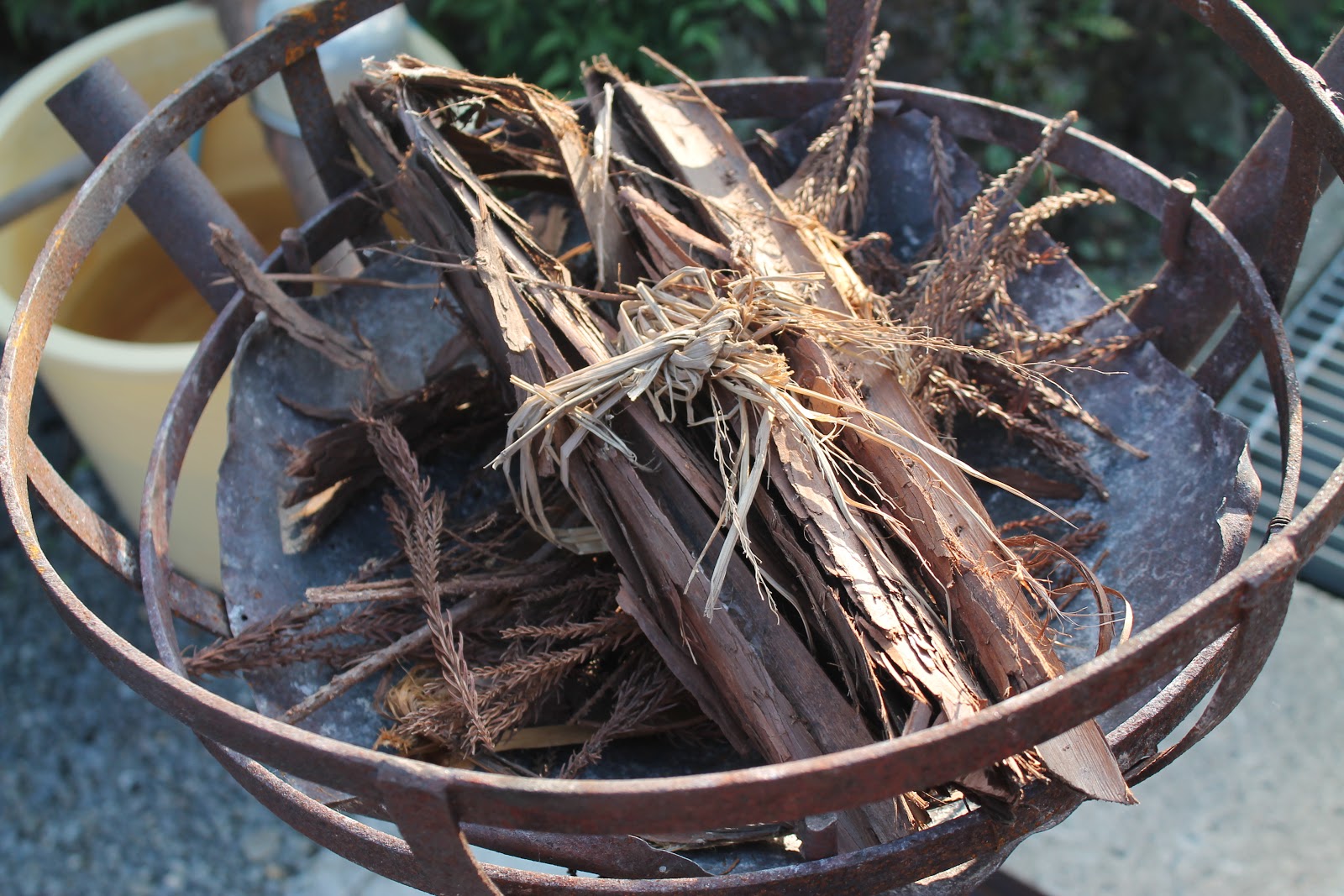
Watching the bonfires and torches be made and put into place was a special treat, so I was happy that I had all day after lunch there. A bonfire started with a simple metal basket (like this one)...

火事の器
...and was constructed by whomever in the house was available at that particular moment. It always started with layer of kindling and dead pine needles, then a layer of pine firewood, followed by a layer of cedar firewood, then topped off with live branches.

おじさん
Assembled taimatsu would be displayed in front of the family home for passerbys to admire, and would sit there basking in the sun, waiting to be lit.

ご家族のたいまつ
This festival is also famous for being deemed among the "top three festivals for eccentrics" in Japan. Who deemed it so or what authority they have, I know not. But as a native of a town that has an Oyster Festival, an All-Species Parade, and a Kinetic Sculpture Race, I think I have the authority to agree with the statement nonetheless.

天狗
Not only do bare-bummed men (wearing the traditional fudoshi undergarment only) carrying 15-foot tall flaming torches make for a laughable sight, but there was also many a Japanese goblin in attendance. These "Tengu" goblins--remnants of Kurama's ancient folklore mythology-- came either in the crow-headed variety or the red-skinned Pinocchio variety, as shown above, and some people's costumes were pretty convincing.

たいまつの木
As the sun started to tuck itself in behind the mountain, I met up with Ishani, who came to Kurama to see the festival with me. We walked around a little bit more before settling in a place to start watching the procession, only to be shooed away from sideline after sideline, until FINALLY somebody let us know that we would have to walk throughout the entire festival, and that's why the police kept ushering everybody away from anyplace they happened to be standing.

安全
Overall, with the Kurama firefighting club, the entire Kyoto police force and fire station crews, and water bins at every house to douse out any unexpected fires, I think they had a town Smokey would be proud of. But that didn't mean it was the safest place ever. I had the misfortune of watching person after person fall down into a hole at the side of the street that was filled with river water (it was a drainage area of some sort) when the sun had gone down and they could no longer see well. Even after a Japanese man got exceeding irked at a police officer who refused to stand watch over that area, I was disappointed in the unenthusiastic solution of putting a traffic cone next to it. But it turned out the traffic cone didn't do any good either. I watched about 6 people fall in, and any one of those times, someone could've easily broken a bone. Sometimes I really hate the tendency in America to sue for every little thing, but it made me upset that nobody seemed willing or able to prevent accidents like that from happening.

kindling
But that was the only bad thing that happened all day, and all of those people were alright, if soaked. Other than those mishaps, from the time the sun went down to the time we left (before the matsuri had ended because we had to get back home before school the following morning) was pure magic.

fire hamlet
Watching the town slowly light up with fire and seeing the citizens walk all over their territory, carrying fire and chanting all the way--it was truly an exceptional Japanese experience. And then I came to a different kind of peaceful solitude from what I had experienced that afternoon on my hike.

”さいれいさいりょう”
ふんどし
たいまつの子供
While it was the first time since coming to Japan that I could see stars above my head (I live in light-pollution waste-land), the fires were more mesmerizing, and the fire of my love for Japan burned even brighter still.